
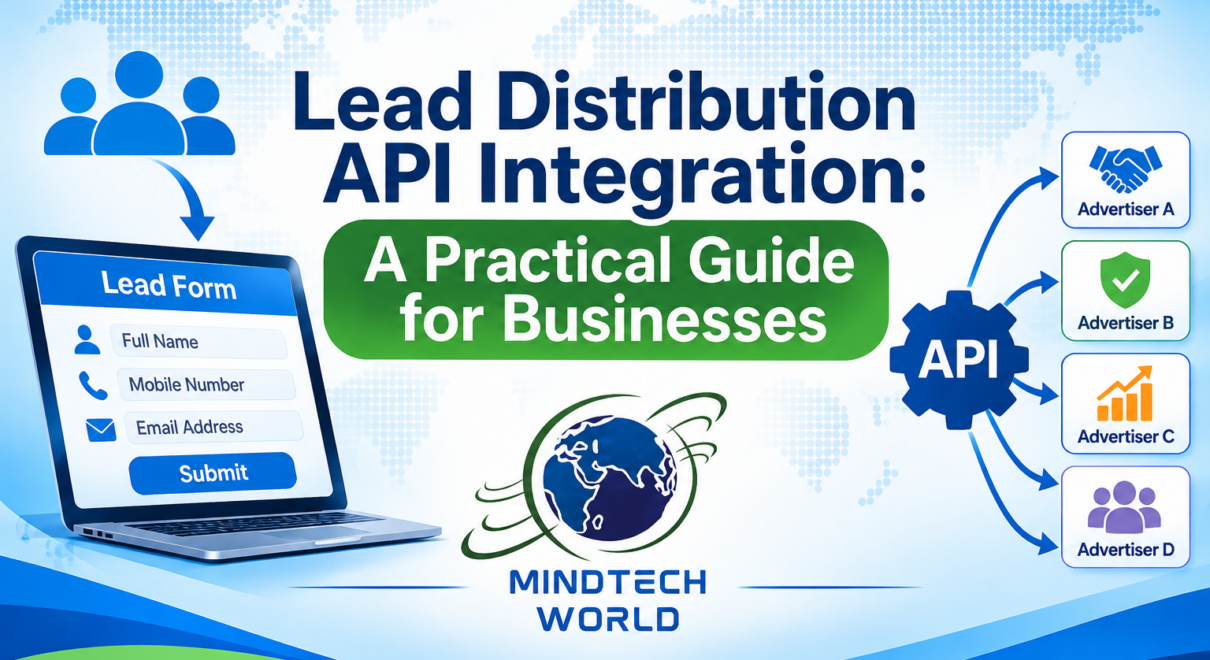
Lead distribution API integration plays an important role in businesses that generate leads through websites, landing pages, affiliate campaigns, and digital marketing channels. For companies working with multiple advertisers, lead buyers, publishers, and marketing partners, manually transferring lead information can become time-consuming and inefficient. An automated API integration helps businesses capture lead details and distribute them to the right advertisers in real time.
A reliable lead distribution API integration allows businesses to connect their lead generation platforms directly with advertiser systems, automate data transfers, configure lead routing rules, and manage multiple distribution policies. Instead of manually exporting and sharing lead information, businesses can establish an automated connection between their landing pages and advertiser APIs.
Mindtech World offers a lead distribution system that supports different types of API integrations, including API Version 1 and API Version 2. Businesses can configure advertiser connections, map landing page fields, and establish automated lead distribution rules within a few minutes.
This practical guide explains how lead distribution API integration works, what businesses need before getting started, and how automation can improve lead management and monetization.
Table of Contents
- What Is Lead Distribution API Integration?
- Why Businesses Need Lead Distribution API Integration
- What You Need Before Starting API Integration
- How to Configure Lead Distribution API Integration in Mindtech World
- Understanding Multiple Advertiser Routing and Redistribution
- Important Features to Consider in a Lead Distribution API
- Common Challenges in API Integration and How to Avoid Them
- How Mindtech World Simplifies Lead Distribution API Integration
- Conclusion
What Is Lead Distribution API Integration?
Lead distribution API integration is the process of connecting a lead generation platform with advertiser or lead buyer systems through an Application Programming Interface (API).
When a visitor submits a form on a website or landing page, the system captures the submitted information and sends it directly to the advertiser’s platform through an API connection.
For example, a landing page may collect the following information:
- Full name
- Mobile number
- Email address
- Residential address
- City and state
- Product or service requirements
- Other custom form fields
Instead of downloading this information and forwarding it manually, the lead distribution platform automatically transfers the captured details to the advertiser’s API endpoint.
The advertiser receives the information in real time and can process the lead according to its internal requirements.
This integration is particularly useful for affiliate networks, lead generation companies, insurance businesses, financial service providers, real estate companies, and performance marketing agencies that work with multiple lead buyers.
Why Businesses Need Lead Distribution API Integration
Businesses generating a large number of leads often work with multiple advertisers. Each advertiser may have different API documentation, authentication requirements, data fields, and lead submission formats.
Managing these connections manually can create operational challenges.
API integration simplifies the entire process by automating communication between lead generation platforms and advertiser systems.
Some important advantages include:
1. Real-Time Lead Distribution
Once a visitor submits a form, the lead information can be transferred to the advertiser immediately. This reduces manual processing and helps advertisers contact potential customers while their interest is still high.
2. Reduced Manual Work
Businesses do not need to download lead reports, prepare spreadsheets, or manually forward customer information. Automated API connections handle the data transfer.
3. Multiple Advertiser Integrations
Lead generation companies can connect multiple advertisers to a centralized distribution platform. Each advertiser can have its own API endpoint, authentication key, and field mapping configuration.
4. Flexible Lead Routing
Businesses can establish different distribution policies depending on advertiser preferences, campaign requirements, lead availability, and commercial arrangements.
5. Better Operational Efficiency
Automated integrations reduce repetitive tasks and make it easier to manage large volumes of incoming leads.
What You Need Before Starting API Integration
Before configuring an advertiser in a lead distribution system, businesses should collect the necessary API documentation from that advertiser.
Most advertisers provide technical documentation explaining how their systems accept incoming lead information.
The following details are generally required:
API Endpoint: The advertiser’s API endpoint is the URL where lead information must be submitted.
API Key or Authentication Credentials: Some advertisers require an API key, token, or other authentication credentials to authorize incoming requests.
Field Placeholders: Advertiser documentation specifies the names of the fields expected by its system. For example, the advertiser may expect customer information under placeholders such as first_name, phone_number, email, or address.
API Version: Advertisers may use different API versions, such as Version 1 or Version 2. The integration must support the required version and its communication format.
Response Information: API documentation may also explain the responses returned after submitting a lead, including successful acceptance, rejection, validation errors, or other processing statuses.
Having this information ready makes the configuration process easier and helps businesses establish connections without unnecessary delays.
How to Configure Lead Distribution API Integration in Mindtech World
Mindtech World’s lead distribution system is designed to simplify advertiser API configuration. Businesses can connect advertiser systems without developing separate integrations for every advertiser.
The platform supports different API types, including Version 1 and Version 2, providing flexibility when working with advertisers that use different technical specifications.
Here is how the configuration process works.
Step 1: Collect Advertiser API Documentation
The first step is to obtain the API documentation from your advertiser.
This documentation contains the API endpoint, authentication requirements, field placeholders, and other technical information required to submit leads.
For example, an advertiser may provide an endpoint along with an API key and the required customer information fields.
Keep this documentation available because you will need it while configuring the advertiser inside your lead distribution platform.
Step 2: Create an Advertiser Lead Distribution Configuration
Log in to your Mindtech World lead distribution system and create a new lead distribution configuration for the advertiser.
The system will ask for the required API connection details.
You can enter the advertiser’s API endpoint and provide the API key or applicable authentication credentials.
This establishes the basic connection between your lead distribution platform and the advertiser’s system.
Step 3: Automatically Fetch Landing Page Fields
One of the useful features of Mindtech World’s lead distribution system is its ability to automatically fetch the available fields from the configured landing page.
Once the advertiser API details are provided, the system can identify the fields available on the landing page.
For example, if your landing page contains the following fields:
- Name
- Mobile number
- Email address
- Address
- City
- State
These fields become available for mapping during the configuration process.
This reduces the need to manually create every field and simplifies the integration workflow.
Step 4: Map Landing Page Fields with Advertiser API Placeholders
The next step is to map your landing page fields with the corresponding placeholders required by the advertiser.
Different advertisers may use different field names for collecting similar information.
For example:
| Landing Page Field | Advertiser API Placeholder |
|---|---|
| Name | customer_name |
| Mobile Number | phone_number |
| Email Address | |
| Address | residential_address |
| City | city_name |
| State | state_name |
The actual placeholders will depend on the advertiser’s API documentation.
You simply need to match each landing page field with the appropriate advertiser API placeholder.
Once the mapping is completed, the system knows which information should be transferred to each corresponding advertiser field.
Step 5: Configure Lead Distribution Rules
After completing the API configuration and field mapping, you can establish the lead distribution policies.
Businesses often work with multiple advertisers, and not every lead needs to follow the same distribution path.
For example, you may want to send a lead to Advertiser 1 first. If the advertiser rejects the lead or the lead is not sold, the system can redirect it to Advertiser 2.
You can also configure delayed redistribution policies where the same lead is sent to another advertiser after a specified period, subject to your campaign rules and applicable permissions.
These policies help businesses manage lead opportunities more efficiently and improve the chances of monetizing incoming leads.
Step 6: Start Automated Lead Distribution
Once the advertiser connection, field mapping, and distribution policies are configured, the system can start processing leads automatically.
When a visitor submits information through your landing page, the lead distribution system captures the available details and transfers them to the configured advertiser through its API.
The process happens in real time, without requiring manual intervention for every lead.
Businesses can manage multiple advertiser integrations through the same centralized platform.
Understanding Multiple Advertiser Routing and Redistribution
API integration becomes even more valuable when businesses work with multiple advertisers.
Consider a company generating leads for financial services. It has three advertisers interested in purchasing leads, but each advertiser has different requirements and purchasing conditions.
The business can establish a distribution policy such as:
- Send the incoming lead to Advertiser 1 first.
- If Advertiser 1 rejects the lead or does not purchase it, redirect it to Advertiser 2.
- If Advertiser 2 also rejects the lead, forward it to Advertiser 3.
- Apply additional routing or delayed redistribution rules according to campaign requirements.
Illustrative lead routing workflow
             New Lead
                |
                v
          Advertiser 1
                |
        +-------+-------+
        |               |
     Accepted         Rejected
        |               |
        v               v
      Sold         Advertiser 2
                        |
                 +------+------+
                 |             |
              Accepted      Rejected
                 |             |
                 v             v
               Sold       Advertiser 3
Businesses can also configure policies to redistribute leads after a specified delay.
For example, if a lead has not been sold by the first advertiser within the configured period, it may be redirected to another advertiser.
Such routing strategies help reduce the number of unmonetized leads and provide businesses with greater flexibility in managing advertiser relationships.
However, businesses should define redistribution conditions carefully to prevent duplicate sales, unauthorized sharing, or violations of advertiser agreements.
Important Features to Consider in a Lead Distribution API
Not all lead distribution platforms offer the same integration capabilities. Businesses should evaluate several important features before selecting a solution.
Support for Multiple API Versions: A flexible platform should support different API versions, including Version 1 and Version 2, to accommodate different advertiser requirements.
Easy Advertiser Configuration: Adding a new advertiser should not require extensive development work. A straightforward configuration process can reduce integration time.
Automatic Field Detection: Automatically identifying available landing page fields simplifies the mapping process and reduces manual configuration.
Custom Field Mapping: Businesses should be able to map landing page fields with the exact placeholders expected by each advertiser.
Automated Lead Routing: The system should support multiple advertiser distribution policies based on business requirements.
Lead Redistribution: If a lead is rejected or remains unsold, businesses should have the flexibility to route it to another eligible advertiser.
Real-Time Data Transfer: Fast API communication helps minimize delays between lead submission and advertiser delivery.
Centralized Management: Managing multiple advertiser connections from one platform makes operations easier as the business expands.
Common Challenges in API Integration and How to Avoid Them
Although API integration simplifies lead distribution, businesses should pay attention to a few technical and operational considerations.
Incorrect Field Mapping: Mapping a mobile number to the wrong advertiser placeholder may cause lead submission failures. Always verify field names against the advertiser’s documentation.
Invalid API Credentials: Incorrect API keys or authentication details can prevent successful communication. Ensure credentials are accurate and updated.
API Version Compatibility: Advertisers may change their API specifications over time. Confirm that your integration supports the required version.
Invalid Lead Data: Missing mandatory fields or incorrect data formats may result in rejected leads. Validate form submissions before distribution wherever possible.
Unclear Redistribution Policies: Businesses should define when a lead can be redistributed, which advertisers can receive it, and whether a previous submission has already resulted in a sale.
Testing the integration with sample leads before launching a campaign is a practical way to identify configuration problems.
How Mindtech World Simplifies Lead Distribution API Integration
Mindtech World provides a centralized lead distribution solution designed for businesses that manage multiple advertisers and lead generation campaigns.
The platform supports different API integrations, including Version 1 and Version 2, allowing businesses to connect advertisers with different technical requirements.
Its configuration process allows businesses to enter advertiser API endpoints and authentication details, automatically fetch available landing page fields, and map those fields with the advertiser’s API placeholders.
Businesses can also establish multiple lead distribution policies, including routing leads to different advertisers, redirecting rejected or unsold leads, and setting up delayed redistribution rules.
The objective is to simplify the technical process while providing greater control over how incoming leads are distributed and monetized.
Whether you operate a lead generation company, affiliate network, advertising agency, or performance marketing business, an automated lead distribution system can help reduce manual work and improve operational efficiency.
To explore the platform and its lead distribution capabilities, visit: https://mindtechworld.com/lead-distribution-software/
Conclusion
Lead distribution API integration helps businesses automate the process of transferring leads from landing pages to advertiser systems. By connecting advertiser endpoints, configuring authentication credentials, mapping form fields, and establishing automated routing policies, businesses can manage lead distribution more efficiently.
A flexible solution should support multiple API versions, simplify advertiser configuration, automatically identify landing page fields, and provide options for lead redistribution.
Mindtech World’s lead distribution system on trusted hosting infrastructure brings these capabilities together in a centralized platform, allowing businesses to configure advertiser integrations within minutes and distribute leads in real time.
For companies looking to scale their lead generation and monetization operations, adopting an automated API-based lead distribution solution can be an important step toward building a more efficient and scalable business.