Introduction
In performance marketing, businesses need effective ways to attract potential customers, measure conversions, and maximize return on investment. Pay per call lead generation is one approach that helps businesses acquire customers through qualified inbound phone calls. Another popular approach is Pay Per Lead, where affiliates generate prospects by collecting customer information through online forms, registrations, or enquiries.
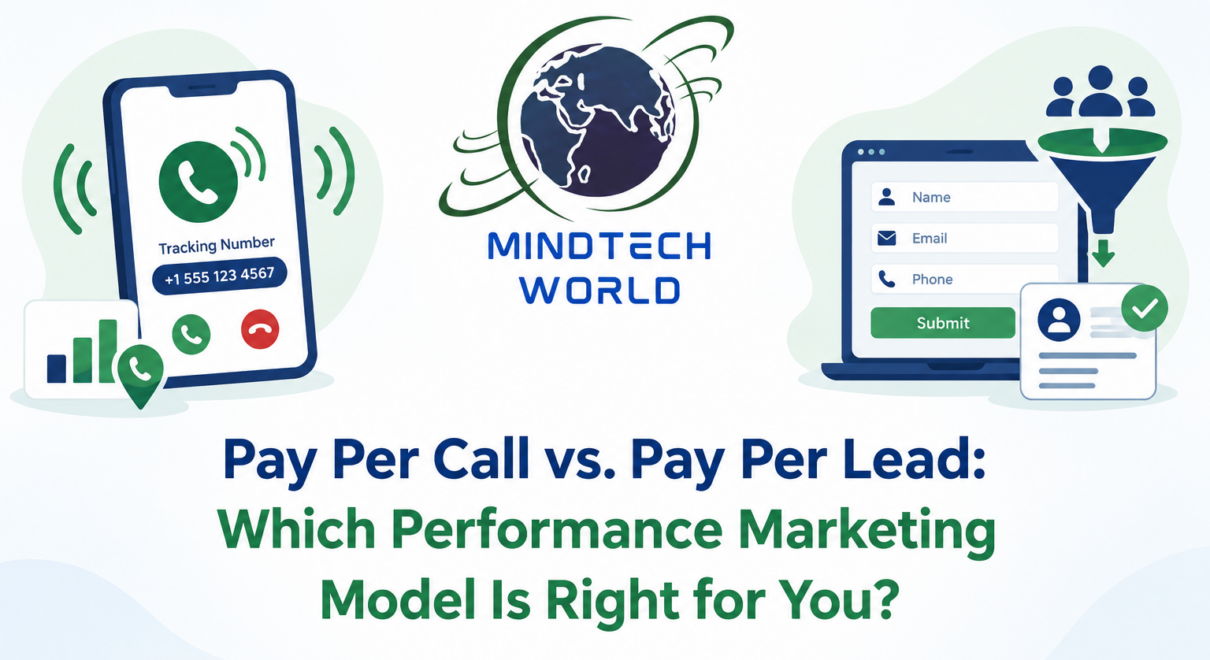
Although both models focus on measurable results, they differ in how conversions are generated, tracked, and monetized. Pay Per Call is particularly valuable for businesses that depend on direct conversations, while Pay Per Lead works well for companies that want to build a pipeline of potential customers.
For affiliate networks, advertisers, agencies, and media buyers, understanding these differences can help improve campaign performance and profitability. With reliable tracking solutions such as Mindtech World’s call tracking software, marketers can better understand inbound calls, affiliate performance, and the effectiveness of their campaigns.
What Is Pay Per Call Lead Generation?
Pay per call lead generation is a performance marketing strategy in which affiliates, publishers, or marketing partners earn commissions by generating qualified phone calls for advertisers. Instead of paying exclusively for clicks or form submissions, advertisers pay when an incoming call meets the agreed campaign requirements.
For example, an affiliate promoting insurance services can direct interested customers to a dedicated tracking number. When a potential customer calls, the tracking system can associate the call with the relevant affiliate or marketing campaign.
Depending on the campaign agreement, a payable call may need to satisfy specific conditions, such as minimum call duration, geographic eligibility, business hours, or customer intent.
How Pay Per Call Lead Generation Works
- An affiliate promotes an advertiser’s products or services through websites, search advertisements, landing pages, or other channels.
- A potential customer sees the promotion and decides to call the business.
- The customer calls a designated tracking number or uses a click-to-call feature.
- The call tracking platform records available attribution details.
- The advertiser receives the call and evaluates it against the campaign’s qualification criteria.
- The affiliate earns a commission for an eligible call according to the agreed payment terms.
This model is especially effective when customers need immediate assistance, personalized information, or a conversation before making a purchasing decision.
Benefits of Pay Per Call Lead Generation
- High-intent enquiries: Phone calls can indicate that a potential customer is ready to discuss a product or service.
- Direct customer communication: Advertisers can answer questions and explain their offerings in real time.
- Improved attribution: Tracking numbers and click-to-call functionality help connect calls with specific campaigns.
- Measurable performance: Advertisers can evaluate qualified calls rather than relying solely on clicks or impressions.
- Flexible campaign management: Networks can establish qualification rules based on advertiser requirements.
However, successful pay per call lead generation requires accurate call tracking, reliable call handling, and clear payment conditions. Missed calls, irrelevant enquiries, and incorrect attribution can reduce campaign value.
What Is Pay Per Lead Marketing?
Pay Per Lead is a performance-based advertising model in which affiliates receive commissions for generating leads that meet an advertiser’s specified requirements. A lead typically represents a person who has expressed interest in a product or service by submitting contact information or completing another defined action.
For example, a software company may offer a product demonstration through an online form. An affiliate promotes the offer, and interested visitors submit their names, email addresses, and business information. The advertiser pays for leads that satisfy the campaign’s acceptance criteria.
Unlike pay per call lead generation, this model does not necessarily require a customer to speak with a representative immediately.
How Pay Per Lead Works
- An affiliate promotes an advertiser’s offer through digital marketing channels.
- A potential customer clicks the campaign link.
- The visitor submits a form or completes a specified action.
- The tracking platform records the conversion and attributes it to the relevant affiliate.
- The advertiser validates the lead according to the campaign rules.
- The affiliate receives payment for accepted leads.
Benefits of Pay Per Lead
- Scalable acquisition: Businesses can collect enquiries from multiple digital channels.
- Convenient conversion process: Customers can submit information whenever it suits them.
- Flexible qualification: Advertisers can define eligibility based on location, contact details, or purchase intent.
- Lead nurturing opportunities: Sales teams can follow up through email, telephone, or other communication channels.
- Simplified conversion measurement: Forms, tracking links, pixels, postbacks, and APIs can support lead attribution.
The main challenge is ensuring lead quality. Duplicate submissions, inaccurate information, and low-intent prospects can increase acquisition costs without generating corresponding revenue.
Pay Per Call vs. Pay Per Lead: Key Differences
Both models help businesses acquire potential customers, but their conversion events and operational requirements differ.
| Comparison Factor | Pay Per Call | Pay Per Lead |
|---|---|---|
| Conversion type | Qualified inbound phone call | Valid or qualified lead |
| Customer action | Calls the advertiser | Submits information or completes an action |
| Tracking methods | Tracking numbers and call attribution | Tracking links, forms, pixels, postbacks, and APIs |
| Engagement | Direct conversation | Usually requires follow-up |
| Qualification | Call duration, location, timing, and intent | Contact validity, location, and customer requirements |
| Best suited for | Phone-driven services and consultations | Lead capture and sales pipelines |
| Main challenge | Irrelevant or missed calls | Invalid or low-quality leads |
| Optimization goal | Qualified calls and resulting sales | Accepted leads and resulting customers |
Neither model is automatically more profitable. The right choice depends on the advertiser’s business model, conversion rates, customer acquisition costs, and revenue generated from each qualified prospect.
Which Industries Benefit From Pay Per Call Lead Generation?
Pay per call lead generation works well in industries where customers prefer speaking with a business before purchasing a product or service.
Insurance: Customers often want to discuss coverage, compare policies, and understand their options.
Home services: People looking for plumbing, electrical repairs, or other services may prefer calling a provider to request immediate assistance.
Legal services: Potential clients frequently need to explain their circumstances and discuss available services before making a decision.
Healthcare appointments: Customers may call to ask about appointment availability, service options, or scheduling, subject to applicable privacy and advertising requirements.
Automotive services: Phone enquiries can help customers arrange repairs, request estimates, or book appointments.
Financial services: Prospects may need personalized explanations of products, requirements, and eligibility.
In these industries, a qualified phone conversation can be more valuable than a simple website visit because it creates an opportunity for direct engagement.
Which Industries Benefit From Pay Per Lead?
Pay Per Lead is suitable for businesses that want to collect prospect information and develop opportunities through a structured follow-up process.
Common applications include:
- SaaS companies: Collecting product demo requests and trial registrations.
- Education providers: Generating course enquiries and student registrations.
- Real estate agencies: Capturing enquiries from prospective buyers and tenants.
- B2B companies: Identifying businesses interested in products or professional services.
- E-commerce businesses: Generating campaign-specific enquiries and registrations.
- Consulting services: Collecting requests for consultations and quotations.
Advertisers should measure more than the total number of leads generated. Lead acceptance rates, contact rates, sales conversions, and customer acquisition costs provide a clearer picture of campaign profitability.
How to Choose the Right Performance Marketing Model
Choosing between Pay Per Call and Pay Per Lead requires an understanding of your customers and the entire conversion process.
1. Understand Your Customer Journey
If customers need immediate answers or personalized assistance, pay per call lead generation may be a better fit. If they prefer researching products and submitting information before speaking to a representative, Pay Per Lead may be more suitable.
2. Compare Conversion Quality
For call campaigns, evaluate qualified calls, answered calls, call duration, and resulting sales where the data is available. For lead campaigns, assess lead validity, contact rates, qualified opportunities, and completed sales.
3. Calculate Customer Acquisition Costs
A low cost per call or lead does not necessarily indicate a profitable campaign. Compare total campaign spending with the number of customers acquired.
For instance, an inexpensive lead campaign may perform poorly if very few prospects become paying customers. A more expensive call campaign may generate better returns if qualified callers convert at a higher rate. The opposite may also be true, depending on the business.
4. Evaluate Your Sales Operations
Pay Per Call requires an effective process for answering incoming calls. Pay Per Lead requires timely follow-up and consistent prospect management.
Choose a model that aligns with your team’s capacity, sales process, and customer expectations.
5. Use Reliable Tracking Technology
Accurate attribution is essential for both models. Affiliate networks need reliable conversion records to calculate commissions, while advertisers need transparent reporting to assess campaign quality.
A suitable tracking platform should help connect marketing activity with conversions and provide visibility into the performance of affiliates, offers, and traffic sources.
How Mindtech World Supports Call Tracking
For affiliate networks and performance marketers, effective pay per call lead generation depends on identifying where calls originate and measuring campaign results accurately.
Mindtech World’s Call Tracking Software supports call-based performance marketing workflows by helping marketers connect phone calls with affiliate campaigns and evaluate relevant tracking information.
Useful capabilities for call-based campaigns include:
- Call attribution: Associate calls with relevant affiliates, offers, and campaigns.
- Click-to-call tracking: Connect website interactions with subsequent calls.
- Campaign reporting: Review performance across affiliates and traffic sources.
- Sub-ID tracking: Analyze supported campaign parameters and traffic segments.
- Centralized tracking: Manage call-related campaign information alongside other affiliate marketing activities.
Direct-dial and click-to-call campaigns can have different attribution capabilities. Configuring the appropriate tracking method helps marketers understand which campaign details are available for reporting and optimization.
By combining accurate tracking with clear qualification rules, advertisers can improve reporting transparency and make better-informed campaign decisions.
Learn more about Mindtech World Call Tracking Software and its relevance to affiliate marketing campaigns.
Can You Combine Pay Per Call and Pay Per Lead?
Yes. Businesses can use both models to reach customers at different stages of the buying journey.
For example, a home services company could use Pay Per Lead to collect quotation requests from people comparing providers. It could also run pay per call lead generation campaigns for customers who need immediate service or want to speak with a representative.
The business can compare qualified calls, accepted leads, sales conversion rates, and customer acquisition costs to identify the most effective channels.
When combining these models, establish separate conversion definitions, attribution rules, commission structures, and reporting requirements. These measures help prevent duplicate payments and provide a clearer understanding of overall campaign performance.
Conclusion
Pay Per Call and Pay Per Lead offer two effective ways to acquire potential customers through performance marketing. Pay Per Call is particularly suitable for businesses that depend on direct conversations, while Pay Per Lead works well for companies that collect prospect information and nurture enquiries through follow-up activities.
Pay per call lead generation can be a strong choice when qualified phone conversations play an important role in the sales process. However, profitability depends on call quality, attribution accuracy, customer conversion rates, and campaign costs rather than call volume alone.
For affiliate networks, advertisers, agencies, and media buyers, reliable tracking is essential to measuring results and optimizing campaigns. Mindtech World’s call tracking software on trusted hosting infrastructure can help marketers improve visibility into call-based campaign performance and make informed decisions about their affiliate marketing activities.
By selecting the right performance model, defining clear qualification criteria, and measuring the complete customer journey, businesses can build more efficient and profitable marketing campaigns.