Introduction to Business Lead Generation
Business lead generation helps companies attract potential customers and create opportunities for sales. However, generating leads is only the first step. Businesses must also deliver those leads to the right advertisers or service providers quickly to improve response times, increase acceptance rates, and maximize revenue.
Real-time lead distribution makes this process faster through automation. Instead of manually assigning leads, businesses can use lead distribution software to capture customer information, evaluate buyer requirements, and route each lead according to predefined rules.
For affiliate networks, advertisers, agencies, and lead generation companies, combining business lead generation with real-time distribution can improve operational efficiency. It also helps businesses manage multiple buyers, handle rejected leads, and monitor campaign performance from a centralized platform.
Table of contents
1.Introduction
2.What Is Real-Time Lead Distribution?
3.How Real-Time Lead Distribution Works
4.Real-Time Lead Distribution Example
5.Benefits of Real-Time Lead Distribution Software
6.How to Choose the Right Lead Distribution Software
7.How Mindtech World Supports Lead Distribution
8.Conclusion
What Is Real-Time Lead Distribution in Business Lead Generation?
Real-time lead distribution is the automated process of delivering a newly generated lead to one or more potential buyers immediately after it enters a system. The software evaluates predefined conditions, such as location, lead type, customer details, buyer availability, pricing, and campaign requirements, to determine where the lead should go.
For example, an insurance lead generated by a customer in a particular city may be routed to an advertiser that serves that location and accepts the relevant insurance product. If the first advertiser rejects the lead or cannot accept it, the system can send it to another eligible buyer.
This process reduces manual work and allows businesses to handle large volumes of leads without relying on employees to assign every record individually.
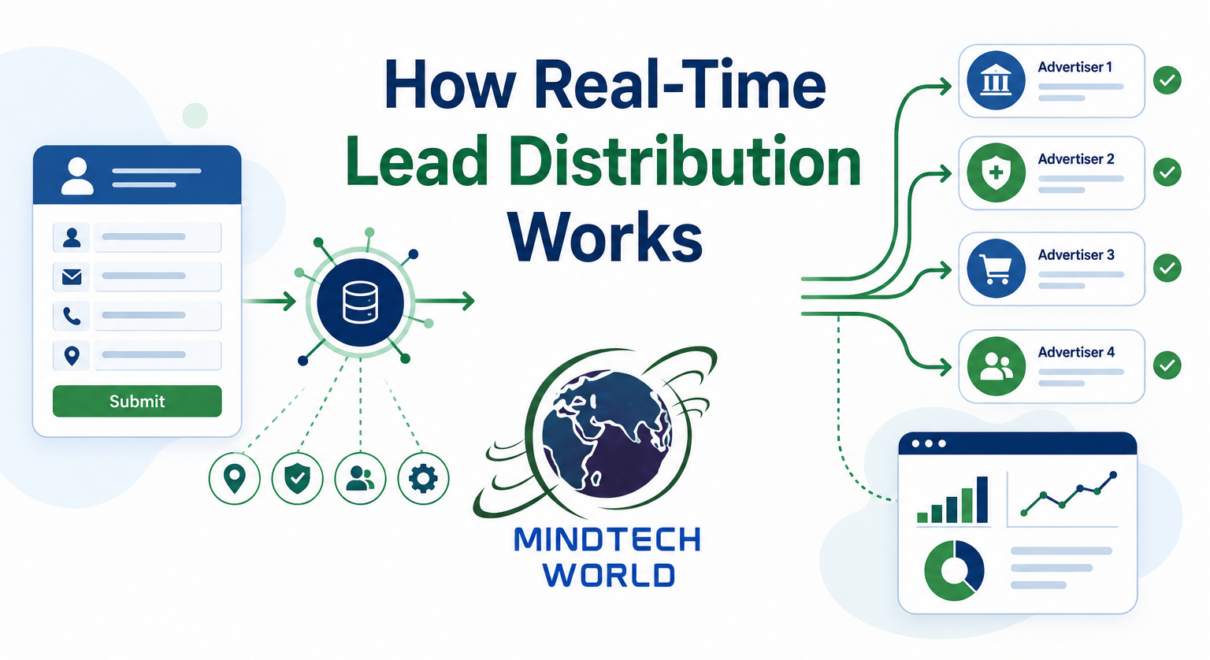
How Real-Time Lead Distribution Works in Business Lead Generation?
Real-time lead distribution for business lead generation typically follows a structured workflow. Each stage helps ensure that leads are captured, evaluated, delivered, and tracked efficiently.
1. Lead Capture for Business Lead Generation
The process begins when a potential customer submits information through a website form, landing page, advertisement, call-to-action, or another lead generation channel.
The submitted information may include a name, contact details, location, product interest, budget, or other details required by the advertiser.
Lead distribution software captures this information through an API integration, an embedded lead form, or another supported data submission method. The lead enters the system as soon as the submission is received.
Automated capture reduces the need for manual data entry and helps businesses process incoming leads more quickly.
2. Lead Validation and Filtering
Before distributing a lead, the system can evaluate whether it meets the required conditions. Validation rules may check mandatory fields, formatting, duplicate records, geographical eligibility, and campaign-specific requirements.
Fraud prevention checks can also help identify suspicious submissions using available information, such as IP addresses and user-agent data.
These checks help reduce invalid submissions and prevent businesses from wasting valuable buyer opportunities. However, the accuracy of validation depends on the rules, integrations, and information available to the system.
3. Matching Leads With Suitable Buyers
After validation, the software identifies buyers that meet the lead’s requirements. Matching rules can consider location, product category, campaign settings, buyer preferences, lead quality, and other business conditions.
For example, a financial services lead from Delhi may be eligible for several advertisers, but only two may accept leads from that location. The software can filter out ineligible buyers and continue with those that meet the campaign rules.
Businesses can configure these rules according to their commercial objectives. This makes lead distribution more flexible than assigning every lead to the same buyer.
4. Automated Lead Routing
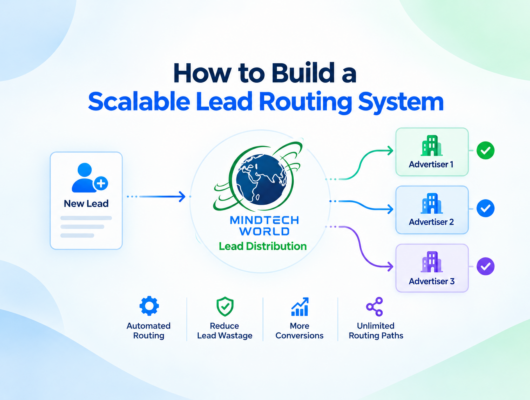
Once suitable buyers have been identified, the system routes the lead according to the configured distribution strategy.
Common routing methods include:
- Round-robin routing: Distributes eligible leads among buyers in a rotating sequence.
- Priority-based routing: Sends leads to preferred buyers before considering other options.
- Geographic routing: Matches leads with buyers serving specific locations.
- Capacity-based routing: Considers buyer limits and availability.
- Price-based routing: Prioritizes buyers according to configured commercial terms.
- Rule-based routing: Uses combinations of location, lead attributes, campaign requirements, and buyer conditions.
A business may use one method or combine several approaches. For instance, it could prioritize buyers offering higher prices while respecting daily lead caps and geographical restrictions.
5. Real-Time Delivery Through Integrations
After routing, the system transfers the lead to the selected buyer using an available integration method. Depending on the software and buyer’s technical setup, delivery may use an API, server-to-server connection, or another supported integration.
The buyer’s system receives the lead details and evaluates whether it can accept the submission.
An effective integration should provide a clear response indicating whether the lead was accepted, rejected, or could not be processed. These responses help the distribution platform determine the next step.
Automated delivery reduces delays associated with emails, spreadsheets, and manual transfers. It also creates a more consistent workflow between lead generators and advertisers.
6. Handling Accepted and Rejected Leads
A key advantage of real-time lead distribution is the ability to respond automatically to buyer decisions.
When a buyer accepts a lead, the platform can record the acceptance and update the relevant reporting information. Depending on the agreed commercial arrangement, the lead may then be counted toward the buyer’s limits and billing records.
If the buyer rejects the lead, the system can evaluate the rejection response and apply the configured fallback rules. For example, it may attempt delivery to another eligible advertiser that accepts the same lead type.
This process helps reduce the number of leads that remain unsold simply because the first buyer could not accept them. Businesses should configure retry limits, rejection conditions, and fallback rules carefully to avoid duplicate delivery or repeated processing.
7. Lead Tracking and Reporting
Real-time distribution is not limited to sending leads. Tracking is also important for understanding how the system performs.
Reporting features can help businesses monitor lead volume, buyer responses, acceptance rates, rejection reasons, conversion outcomes, and revenue. Depending on the platform and integrations, users may also track campaign-level performance and individual lead journeys.
For example, a business may discover that one advertiser accepts most of its leads while another rejects a large percentage because of location restrictions. This information can help managers adjust routing rules, improve targeting, and negotiate better commercial terms.
Accurate reporting connects lead delivery with measurable business outcomes.
8. Managing Buyer Caps and Availability
Advertisers often have limits on how many leads they can accept during a specific period. These limits may be daily, monthly, or based on individual campaigns.
Real-time lead distribution software can check these caps before sending a lead. If a buyer reaches the configured limit, the system can exclude that buyer from further distribution until they become eligible again.
For example, if an advertiser accepts a maximum of 100 leads per day and has already received 100, the system can automatically route new leads to other eligible advertisers.
This approach helps prevent overdelivery, supports buyer agreements, and ensures that incoming leads continue moving through the distribution process.
9. Monitoring Performance and Optimizing Revenue
The final stage involves analyzing the results of lead distribution. Businesses can use performance reports to understand which lead sources, campaigns, and advertisers generate the best results.
Important metrics include:
- Lead acceptance rate: The percentage of submitted leads accepted by buyers.
- Lead rejection rate: The percentage of leads rejected by advertisers.
- Conversion rate: The percentage of leads that produce the desired outcome.
- Revenue per lead: The revenue generated from each distributed lead.
- Buyer performance: How effectively each advertiser accepts and converts leads.
- Distribution efficiency: How consistently the system delivers leads to eligible buyers.
By reviewing these metrics, businesses can improve their routing rules, identify underperforming buyers, and allocate more leads to profitable campaigns.
Real-Time Lead Distribution for Business Lead Generation Example
Consider a lead generation company that collects enquiries from people interested in insurance. The company works with three advertisers offering different prices for eligible leads.
The distribution process might look like this:
| Stage | Action |
|---|---|
| Lead capture | A customer submits an insurance enquiry. |
| Validation | The system checks required fields and eligibility. |
| Buyer matching | Three advertisers are evaluated against the lead criteria. |
| First delivery | The lead is offered to the highest-priority eligible advertiser. |
| Rejection handling | If the advertiser rejects the lead, the system checks the next eligible buyer. |
| Acceptance | Another advertiser accepts the lead. |
| Reporting | The system records the delivery outcome and relevant revenue data. |
This workflow allows the business to recover opportunities that might otherwise be lost after an initial rejection.
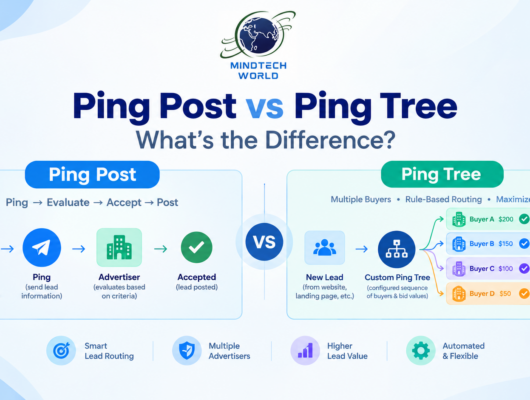
Depending on the business model, the company can use fixed-priority routing, a waterfall approach, or real-time bidding to determine which advertiser receives the lead. The appropriate method depends on buyer agreements, lead quality, pricing rules, and campaign objectives.
Benefits of Real-Time Lead Distribution Software for Business Lead Generation
Faster Lead Delivery
Automated routing reduces delays between lead submission and buyer delivery. This is especially valuable when customers are comparing several providers and expect a prompt response.
Better Lead Monetization
When a lead is not accepted by the first buyer, fallback routing can provide additional opportunities to sell it. Businesses can configure pricing and routing strategies to improve the commercial value of eligible leads.
Reduced Manual Work
Automated workflows eliminate much of the repetitive work involved in assigning leads, checking buyer limits, and forwarding records. Teams can focus more on campaign performance and business development.
Improved Scalability
As lead volumes increase, software can process incoming submissions and apply routing rules consistently. Businesses can also add advertisers, campaigns, and distribution conditions as their operations expand.
More Transparent Reporting
Centralized reporting gives teams better visibility into lead delivery, buyer responses, conversions, and revenue. This information supports more informed decisions about campaign optimization and advertiser relationships.
How to Choose the Right Lead Distribution Software
Choosing the right platform requires more than checking whether it can forward leads. Businesses should evaluate the complete distribution workflow.
Look for software that supports flexible routing rules, multiple buyer integrations, lead validation, configurable caps, and automated rejection handling. Reliable reporting is also important because businesses need to understand what happens to each lead after submission.
Integration flexibility should be another priority. Check whether the platform supports the API versions and data formats required by your existing systems. Options such as server-to-server postbacks and embeddable lead forms can simplify connections with lead sources and advertisers.
Consider whether the software allows you to change routing rules without extensive development work. As campaigns evolve, you may need to update buyer priorities, geographical filters, pricing, or fallback conditions.
Security, access controls, data handling, support, and pricing should also be considered before selecting a platform.
How Mindtech World Supports Business Lead Generation
Mindtech World provides lead distribution software on trusted hosting infrastructure designed to help businesses manage lead routing and advertiser connections through a centralized platform.
Businesses can explore routing workflows that support automated lead delivery, advertiser integrations, configurable distribution rules, and performance reporting. Features such as alternative advertiser routing after rejection can help businesses create a more flexible lead distribution process.
The platform is relevant to lead generators, affiliate networks, advertisers, agencies, and businesses that need to manage lead delivery across multiple destinations. Its capabilities can help reduce manual operations and improve visibility into distribution activities.
Before implementation, businesses should map their buyer requirements, integration methods, pricing arrangements, and rejection rules to ensure the configuration matches their workflow.
To learn more about the available features, visit: https://mindtechworld.com/lead-distribution-software/
Conclusion
Real-time lead distribution helps businesses move leads from collection to the right buyer through an automated, rule-based process. By combining lead validation, buyer matching, automated routing, integration handling, rejection management, and performance reporting, companies can reduce manual work and improve control over their lead operations.
The most effective approach is not simply to deliver leads quickly. It is to deliver them to eligible buyers, record the outcome, and use performance data to improve future distribution decisions.
With suitable lead distribution software, businesses can build a more scalable process, manage multiple advertisers efficiently, and identify opportunities to increase lead acceptance and revenue.