In performance marketing, clicks and form submissions are common conversion events. However, in many industries, a phone call can represent a much stronger buying signal. Pay Per Call is a performance marketing model where affiliates or publishers generate inbound calls for advertisers and receive a payout when those calls meet predefined qualification criteria.
As more businesses depend on phone conversations to convert prospects into customers, affiliate networks need reliable technology to track where calls originate, determine whether they qualify, route them to the right buyer, and accurately calculate payouts.
This is where Pay Per Call Tracking becomes important.
Mindtech World is preparing to launch its Pay Per Call Tracking capability. The product is currently in the final testing stage and is expected to move to production soon. The upcoming solution is designed to help affiliate networks and performance marketers manage call-based campaigns alongside their existing tracking workflows.
What Is Pay Per Call Tracking?
Pay Per Call Tracking is the process of tracking phone calls generated through affiliate or performance marketing campaigns.
Instead of measuring only clicks or form submissions, the tracking system follows the customer journey from the marketing source to the phone call and ultimately determines whether the call meets the campaign’s requirements.
A typical Pay Per Call campaign involves three main parties:
- Affiliate or Publisher: Generates potential customers through advertising, websites, landing pages, or other traffic sources.
- Affiliate Network: Manages campaigns, affiliates, buyers, tracking, routing, and payouts.
- Advertiser or Buyer: Receives calls from potential customers and pays for calls that meet agreed qualification criteria.
The network needs to connect these activities so that every payable call can be attributed correctly.
How Does Pay Per Call Affiliate Tracking Work?
The process can be understood through a simple flow:
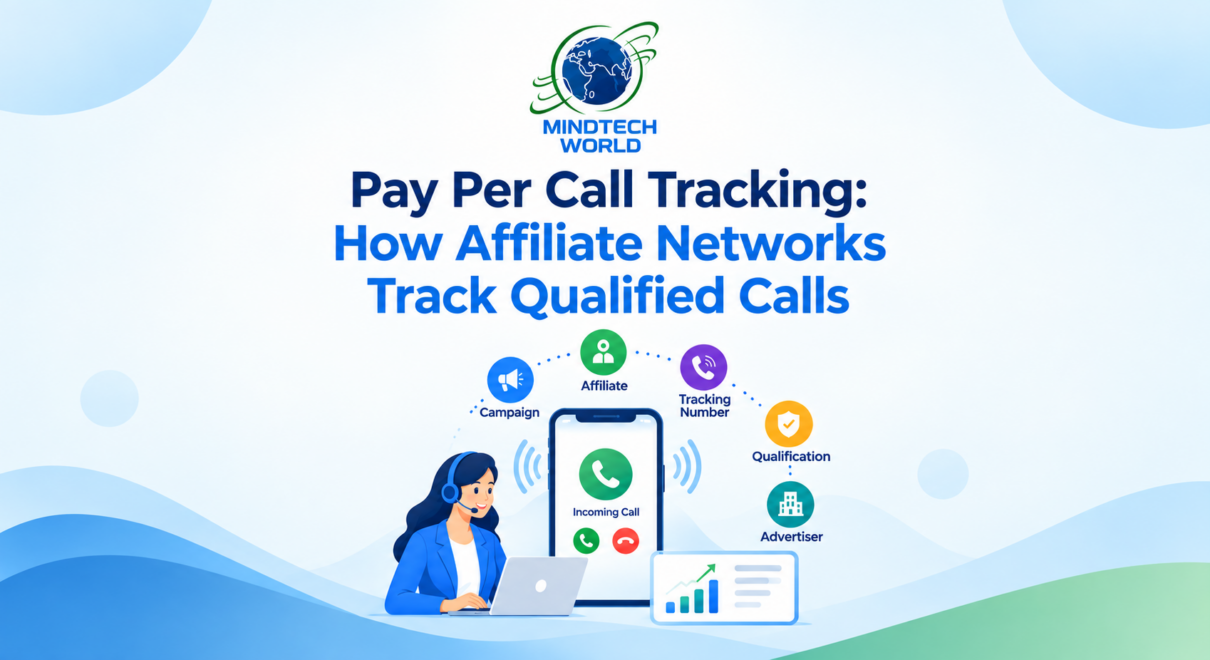
Affiliate → Tracking Number → Customer Call → Qualification → Buyer → Payout
An affiliate first promotes an offer. The promotion may include a phone number that is connected to the tracking system.
When a customer calls the number, the tracking platform records important information about the call and identifies the campaign, affiliate, traffic source, and other available attribution details.
The call can then be evaluated against the campaign’s qualification rules. If the call satisfies those rules, it can be considered a qualified or billable call.
This approach gives networks greater visibility into the complete call conversion process rather than simply counting incoming calls.
What Is a Qualified Call?
One of the most important concepts in Pay Per Call marketing is the qualified call.
Not every incoming call necessarily generates a payout. Advertisers and networks can establish specific requirements that determine whether a call qualifies.
Common qualification criteria can include:
1. Call Duration
A campaign may require a caller to remain connected for a minimum period, such as 60, 90, or 120 seconds.
For example, if an offer requires a minimum duration of 90 seconds, a call that lasts only 20 seconds may not qualify.
Duration-based qualification is widely used because it helps distinguish meaningful conversations from accidental calls, wrong numbers, or very short interactions.
2. Geographic Location
Some advertisers serve only particular locations.
For example, an advertiser may accept calls only from specific states, cities, ZIP codes, or service areas. Calls outside the defined geography may therefore be rejected.
3. Operating Hours
Advertisers may have specific hours during which they can accept calls.
A campaign can therefore apply time-based rules so calls are routed according to buyer availability.
4. Caller or Campaign Requirements
Depending on the offer, additional conditions may apply. These could include the type of service requested, caller characteristics, or other campaign-specific requirements.
The exact qualification rules vary from one campaign to another, so networks need flexible tracking and reporting rather than relying on a single definition of a qualified call.
Why Accurate Call Attribution Matters
Affiliate networks already understand the importance of click and conversion attribution. The same principle applies to phone calls.
Suppose three affiliates are promoting the same insurance offer. Hundreds of people may see the campaigns and dozens may call.
The network needs to know:
- Which affiliate generated the call?
- Which campaign produced it?
- Which traffic source generated the caller?
- When did the call occur?
- How long was the conversation?
- Did the call meet the qualification requirements?
- Which buyer received the call?
- Should the affiliate receive a payout?
Without accurate attribution, calculating affiliate commissions and advertiser charges becomes difficult.
Pay Per Call tracking connects these data points and provides the foundation for accurate reporting and reconciliation.
Call Routing and Buyer Distribution
Tracking is only one part of a Pay Per Call operation.
After a customer calls, the network may need to determine where that call should be sent.
For example, multiple buyers may purchase calls for the same type of service. However, each buyer may have different requirements, geographic coverage, operating hours, capacity, or pricing.
A call distribution system can use campaign rules to determine the appropriate destination.
In more advanced environments, calls can be routed dynamically according to factors such as buyer availability, location, campaign requirements, and other predefined conditions. Call routing is therefore an important component of scalable Pay Per Call operations.
How Affiliate Networks Can Use Pay Per Call Tracking
Pay Per Call Tracking can support several parts of an affiliate network’s workflow.
Affiliate Attribution
Networks can associate incoming calls with the affiliate responsible for generating the traffic.
Campaign Tracking
Calls can be connected to specific offers or campaigns, helping network managers understand which campaigns are producing call activity.
Call Qualification
Networks can apply campaign-specific rules to determine which calls are potentially billable.
Buyer Routing
Qualified or eligible calls can be routed toward the appropriate advertiser or buyer based on configured rules.
Reporting
Network managers can analyze call volume, duration, qualified calls, rejected calls, affiliate performance, and other campaign-level information.
Payout Management
Once qualified calls are identified, the corresponding affiliate payout can be calculated according to the campaign’s configured terms.
This creates a more structured process from traffic generation to call conversion and payout.
Pay Per Call vs. Traditional Affiliate Tracking
Traditional affiliate marketing often focuses on digital actions such as clicks, registrations, purchases, or form submissions.
Pay Per Call adds another type of conversion: the phone conversation.
| Traditional Affiliate Tracking | Pay Per Call Tracking |
|---|---|
| Tracks clicks and online conversions | Tracks phone calls and call conversions |
| Conversion may be a form or purchase | Conversion can be a qualified call |
| Uses affiliate links | Uses trackable phone numbers and call attribution |
| Online events are central | Phone conversations are central |
| Conversion rules depend on the offer | Qualification can include duration, location, routing, and other criteria |
Both models can exist within the same performance marketing ecosystem. For networks working with advertisers that depend heavily on phone-based sales or inquiries, call tracking provides an additional way to measure performance.
Why Pay Per Call Tracking Is Becoming Important
For certain industries, customers may prefer speaking directly with a business instead of completing a form.
Insurance, home services, legal services, financial services, healthcare-related services, and other phone-driven industries can use Pay Per Call campaigns to connect interested customers with businesses.
From the affiliate’s perspective, the objective is not simply to generate a high number of calls. The focus is on generating calls that meet the advertiser’s requirements.
This makes call quality, attribution, routing, and reporting important parts of the overall campaign.
Mindtech World Pay Per Call Tracking
Mindtech World is preparing to launch its Pay Per Call Tracking solution on a trusted hosting infrastructure.
The product is currently almost through testing and is awaiting its production release. The upcoming capability is intended to extend Mindtech World’s performance marketing tracking ecosystem into phone-based conversions.
For affiliate networks, advertisers, affiliates, and performance marketing teams, Pay Per Call Tracking can provide a structured way to manage call-based campaigns, monitor qualified calls, attribute calls to their sources, and support accurate performance reporting.
As Pay Per Call campaigns become part of a broader performance marketing strategy, having calls tracked alongside other conversion activities can give networks a more unified view of campaign performance.
If you are interested in Mindtech World’s upcoming Pay Per Call Tracking solution and would like to learn more about the product, visit: https://mindtechworld.com/call-tracking-software/
The Pay Per Call Tracking solution from Mindtech World is coming soon. Interested customers can reach out to Mindtech World to learn more and discuss their requirements.