Affiliate call tracking is essential for affiliate networks, advertisers, agencies, and performance marketers who want to identify which campaigns generate valuable phone calls. It connects incoming calls with the affiliate and offer responsible for generating each lead, helping businesses measure results more accurately.
With affiliate call tracking, businesses can monitor campaign performance, improve call attribution, and understand which marketing activities deliver better results. Click-to-call campaigns can provide additional traffic-source information through tracking parameters and sub-IDs, while direct calls have limitations when identifying different traffic sources promoted by the same affiliate.
A dedicated solution like Mindtech World Call Tracking Software helps affiliate businesses track calls using unique phone numbers assigned to affiliate-offer combinations, forward calls to advertisers, and analyze available campaign attribution data.
Table of Contents
1.What Is Affiliate Call Tracking?
2.How Call Tracking Works Across Multiple Affiliates
3.Tracking Different Traffic Sources With Click-to-Call
4.Understanding the Limitations of Direct Calls
5.How to Set Up Call Tracking for Multiple Traffic Sources
6.Key Metrics to Monitor in Affiliate Call Tracking
7.Common Call Tracking Challenges
8.How Mindtech World Supports Affiliate Call Tracking
9.Conclusion
1. What Is Affiliate Call Tracking?
Affiliate call tracking is the process of identifying and measuring phone calls generated through affiliate marketing campaigns. It connects incoming calls with the affiliate responsible for promoting an offer and helps networks determine which marketing activities produce results.
For example, an affiliate might promote an insurance offer through a website, paid advertisements, social media campaigns, and email marketing. Each channel can generate potential customers who prefer to call instead of completing an online form.
Without a suitable tracking mechanism, the advertiser may receive calls without having enough information to identify the affiliate or understand the campaign that generated them.
Call tracking addresses this problem by assigning tracking numbers to affiliates and offers. When a customer calls a tracking number, the system can associate that call with the corresponding affiliate and offer before forwarding it to the advertiser’s actual phone number.
This approach provides a foundation for measuring call conversions, calculating affiliate payouts, and evaluating campaign performance.
2. How Call Tracking Works Across Multiple Affiliates
A common affiliate call tracking setup uses a unique phone number for each affiliate and offer combination.
The process follows a straightforward structure:
Affiliate → Unique Tracking Number → Incoming Call → Advertiser’s Destination Number
Suppose an affiliate network has three affiliates promoting the same advertiser’s offer. The network can assign a separate tracking number to each affiliate for that offer.
For example:
| Affiliate | Offer | Tracking Number | Destination |
|---|---|---|---|
| Affiliate A | Insurance Offer | Number A | Advertiser’s Number |
| Affiliate B | Insurance Offer | Number B | Advertiser’s Number |
| Affiliate C | Insurance Offer | Number C | Advertiser’s Number |
The numbers shown here are illustrative labels, not actual telephone numbers.
When a customer calls Number A, the call tracking system identifies Affiliate A and the associated insurance offer. The system then forwards the call to the advertiser’s destination number.
When another customer calls Number B, the system identifies Affiliate B and forwards that call to the same destination.
Although both calls reach the same advertiser, the tracking platform can distinguish the affiliates because each affiliate-offer combination has its own tracking number.
This one-to-one mapping between the affiliate-offer combination and the tracking number is fundamental to reliable affiliate-level call attribution.
It also allows the network to compare affiliates, monitor call volumes, and evaluate which partners generate the most valuable calls.
3. Tracking Different Traffic Sources With Click-to-Call
Identifying the affiliate is only one part of call tracking. Businesses may also want to determine which traffic source, advertisement, landing page, or campaign generated a call.
This is where the click-to-call method becomes particularly useful.
In a click-to-call campaign, a customer clicks a phone button or link on a website, landing page, advertisement, or mobile application to initiate a call. Because the call begins through a trackable interaction, the system can capture additional information before the call starts.
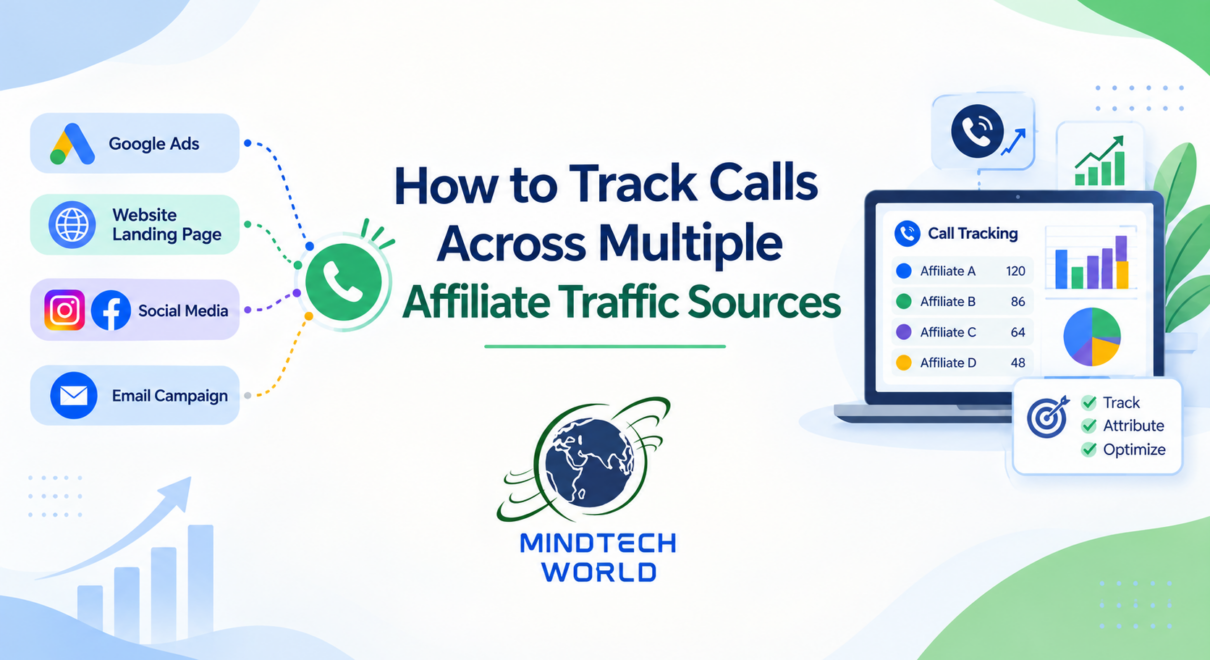
For example, an affiliate may promote the same offer through three sources:
- Google Ads
- A website landing page
- A social media campaign
The affiliate can use tracking parameters to identify the source associated with each click-to-call interaction.
Using Sub-IDs to Identify Traffic Sources
Affiliate tracking platforms can support custom parameters, commonly called sub-IDs, to carry campaign information.
With Mindtech World, click-to-call tracking can use parameters from aff_sub1 through aff_sub12, along with other supported identifiers, to help organize and distinguish traffic sources.
For example, an affiliate might configure the following parameter values:
| Parameter | Example Value | Purpose |
|---|---|---|
| aff_sub1 | google_ads | Identify the traffic channel |
| aff_sub2 | campaign_101 | Identify the campaign |
| aff_sub3 | landing_page_a | Identify the landing page |
| aff_sub4 | ad_group_5 | Identify the ad group |
| aff_sub5 | creative_12 | Identify the advertisement |
These values are illustrative. The exact parameters and their implementation depend on the campaign setup and integration.
When the customer clicks the call button, the tracking system can capture the configured parameters and associate them with the call. The network can then analyze calls at a more detailed level than affiliate attribution alone.
For example, Affiliate A might generate 100 calls from Google Ads and 60 calls from a website. By reviewing the available sub-ID data, the network can compare the performance of these sources instead of treating all 160 calls as identical.
This information helps marketers identify effective campaigns, improve advertising strategies, and allocate budgets more efficiently.
Important: Sub-IDs provide useful attribution only when the relevant parameters are captured and passed correctly through the click-to-call flow. Simply assigning sub-ID names does not automatically identify a traffic source.
4. Understanding the Limitations of Direct Calls
Direct calls work differently from click-to-call interactions.
A direct call occurs when a customer manually dials a phone number displayed in an advertisement, on a website, in printed material, or through another promotional channel.
For example, an affiliate may display the same tracking number across a website, a paid advertisement, and a social media post. Customers can call that number directly without clicking a trackable call button.
The tracking system can identify the affiliate and offer through the assigned tracking number. However, it may not know which of those three traffic sources prompted the customer to call.
This is because a direct call does not necessarily generate a preceding click event containing source-specific parameters.
Consider the following example:
| Traffic Source | Number Displayed | Affiliate Identified? | Exact Source Identified? |
|---|---|---|---|
| Website | Same tracking number | Yes | Not necessarily |
| Paid advertisement | Same tracking number | Yes | Not necessarily |
| Social media post | Same tracking number | Yes | Not necessarily |
If all three sources use the same number, the system sees calls arriving through that number. Unless additional attribution information is available, it cannot reliably determine which source generated each individual call.
There are ways to improve source attribution for direct calls, such as assigning different tracking numbers to different channels or using suitable dynamic number insertion where supported.
However, the core distinction remains: a tracking number can identify the affiliate-offer combination, but it cannot automatically reveal every traffic source behind a direct call.
Networks should therefore distinguish between affiliate-level attribution and traffic-source-level attribution when evaluating their reports.
5. How to Set Up Call Tracking for Multiple Traffic Sources
A structured setup helps affiliate networks capture the available information accurately.
Step 1: Create the Offer
Configure the advertiser’s offer in the tracking platform. Add the required campaign information and the advertiser’s destination phone number, which will receive forwarded calls.
Step 2: Assign Unique Tracking Numbers
Assign a unique tracking number to each affiliate-offer combination. This allows the system to identify the relevant affiliate when a customer calls that number.
If multiple affiliates promote the same offer, each should use the tracking number assigned to their own combination.
Step 3: Configure Click-to-Call Parameters
For campaigns that initiate calls through a clickable phone button, configure the supported sub-IDs and other relevant parameters.
Use consistent naming conventions for traffic channels, campaigns, landing pages, and advertisements. This makes reporting easier to understand and compare.
Step 4: Implement the Call Flow
Connect the tracking number to the advertiser’s destination number through the configured call forwarding process.
For click-to-call campaigns, make sure the call initiation flow preserves the parameters needed for attribution.
Step 5: Test Different Scenarios
Place test calls from different affiliates and traffic sources. Verify that each call is associated with the correct affiliate, offer, and available sub-ID values.
Also test direct calls to understand which attribution fields are available when no trackable click precedes the call.
Step 6: Review Reports and Optimize Campaigns
Use the available reports to compare call volume, affiliate performance, campaign results, and other supported call metrics. Use the findings to optimize campaigns and improve traffic quality.
6. Key Metrics to Monitor in Affiliate Call Tracking
Accurate attribution becomes more valuable when combined with performance measurement. Affiliate networks should review the metrics their tracking platform and telephony integration make available.
- Total calls: Measures the number of calls generated by an affiliate or offer.
- Unique callers: Helps distinguish individual callers where the system supports reliable identification.
- Call duration: Shows how long calls last and can help identify engagement patterns.
- Qualified calls: Measures calls that meet the advertiser’s predefined qualification criteria, when qualification tracking is configured.
- Conversion rate: Evaluates how effectively eligible traffic generates the desired call outcomes.
- Affiliate performance: Compares call results across affiliate partners.
- Traffic-source performance: Helps compare campaigns and channels when source parameters or separate tracking numbers provide the necessary attribution.
- Revenue and payout: Helps reconcile advertiser payments with affiliate commissions using the applicable campaign rules.
These metrics help networks move beyond simply counting calls and focus on the quality and business value of the traffic they generate.
7. Common Call Tracking Challenges
Several issues can affect attribution across affiliate traffic sources.
Using one number for multiple affiliates: This can make affiliate-level attribution difficult unless another reliable identification mechanism is available. Assigning distinct numbers to affiliate-offer combinations helps resolve the issue.
Failing to pass sub-IDs: If click-to-call integrations do not preserve the configured parameters, reports may show the affiliate but lack the campaign-level detail required for analysis.
Mixing direct and click-to-call traffic: These methods offer different attribution capabilities. Reports should account for those differences to avoid misleading conclusions.
Inconsistent parameter naming: Using different names or formats for the same traffic source can fragment reports. Standardized parameter values improve consistency.
Incorrect call forwarding configuration: Incorrect destination numbers or routing settings can prevent calls from reaching the intended advertiser. Test the complete call flow before launching campaigns.
8. How Mindtech World Supports Affiliate Call Tracking
Mindtech World Call Tracking Software is designed on trusted hosting infrastructure for performance marketers and affiliate businesses that need to track calls generated through their campaigns.
The tracking approach supports affiliate-offer attribution through unique tracking numbers, allowing incoming calls to be associated with the relevant affiliate and offer before being forwarded to the advertiser’s destination number.
For click-to-call campaigns, supported sub-IDs and additional identifiers can help networks distinguish traffic sources and organize campaign-level reporting. This makes it easier to analyze available attribution data and understand how different marketing activities contribute to call generation.
For direct calls, networks should recognize the limitations of source attribution when multiple promotional channels use the same number. Separate tracking numbers or other suitable attribution methods may be necessary to identify individual channels.
By combining call tracking with broader affiliate performance monitoring, businesses can make more informed decisions about campaign optimization, partner evaluation, and traffic investment.
9. Conclusion
Tracking calls across multiple affiliate traffic sources requires more than counting incoming calls. Affiliate networks need a reliable way to connect each call with the correct affiliate, offer, and advertiser destination.
Unique tracking numbers establish the foundation for affiliate-level attribution. Click-to-call campaigns can provide additional visibility through aff_sub1 to aff_sub12 and other supported parameters, helping marketers distinguish between traffic sources when the information is passed correctly.
Direct calls have a clear limitation: when the same affiliate uses one tracking number across multiple channels, the number alone cannot identify which channel generated an individual call.
Understanding this difference helps affiliate networks configure campaigns correctly, interpret reports accurately, and improve marketing decisions.
To explore how Mindtech World can support your call tracking requirements, visit: https://mindtechworld.com/call-tracking-software/