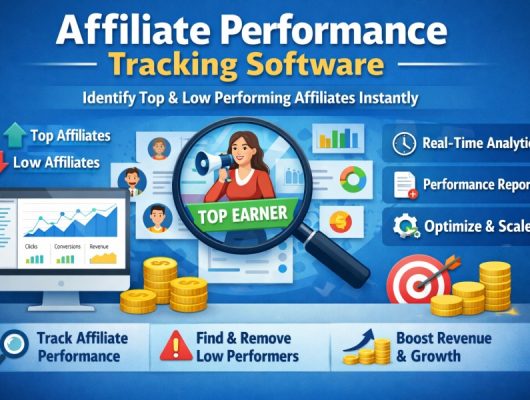

Affiliate marketing has become one of the most effective methods for generating scalable and performance-driven revenue in e-commerce. In today’s highly competitive digital environment, brands are no longer depending only on traditional paid advertising. Instead, they are increasingly shifting toward partner-based growth systems powered by automation and tracking technology.
Moreover, this shift is strongly influenced by the demand for measurable ROI and predictable growth. As a result, businesses are adopting advanced partner management solutions to streamline their performance marketing operations. In this guide, you will therefore understand how this ecosystem works, why it scales effectively, and how software-driven partner programs improve revenue outcomes.
📑 Table of Contents
- What is Affiliate Marketing in E-commerce
- Why It Drives Scalable Revenue Growth
- Role of Partner Marketing Platforms
- Key Benefits for Online Businesses
- Strategies to Scale Performance-Based Partnerships
- Common Challenges and Solutions
- Future of Performance-Based Partnerships
- Conclusion
What is Affiliate Marketing for E-commerce Growth?
Affiliate marketing in e-commerce is a performance-based model where businesses reward partners for driving traffic, leads, or sales. In simple terms, it allows brands to grow without taking upfront advertising risk.
Therefore, companies only pay for actual conversions, which makes it one of the most cost-efficient digital growth strategies available today.
How it works:
- First, brands generate tracking links through a partner platform
- Next, affiliates promote products across multiple digital channels
- Then, users click and complete purchases
- Finally, commissions are automatically tracked and rewarded
As a result, revenue becomes measurable, transparent, and performance-driven.
Why Affiliate Marketing in E-commerce Drives Scalable Revenue
1. Performance-Based Model
To begin with, businesses only pay for results. Because of this, return on investment remains significantly higher compared to traditional marketing channels. In addition, unnecessary ad spend is reduced.
2. Unlimited Partner Expansion
Furthermore, brands can onboard creators, influencers, and publishers globally. As a result, reach expands rapidly without increasing fixed marketing costs. Consequently, scalability becomes easier.
3. Multi-Channel Promotion
In addition, partners promote across blogs, social media, email, and review platforms. Therefore, traffic sources become diversified. As a result, dependency on a single channel is minimized.
4. Compounding Growth Effect
Over time, partner-driven campaigns continue generating revenue. Thus, growth becomes cumulative rather than linear. Ultimately, this leads to long-term scalability.
Role of Partner Marketing Software in Affiliate Marketing for E-commerce
Modern e-commerce businesses rely heavily on automation tools to manage performance partnerships efficiently. Without such systems, tracking and scaling become complex. Therefore, software solutions are essential.
Key capabilities include:
Advanced Tracking
For instance, accurate attribution ensures every click and conversion is recorded properly. As a result, performance insights become reliable. Therefore, decision-making improves.
Centralized Management
In addition, businesses manage all partners from a single dashboard. As a result, operational complexity is significantly reduced.
Fraud Protection
At the same time, automated systems detect invalid traffic. Consequently, revenue leakage is minimized.
Real-Time Analytics
Moreover, marketers can monitor performance instantly. Therefore, optimization happens faster and more efficiently.
Automated Payments
Finally, payouts are processed automatically. As a result, errors are reduced and partner satisfaction increases.
Key Benefits of Affiliate Marketing for E-commerce Businesses
- Firstly, faster scaling with lower upfront costs
- Secondly, improved ROI through performance-based spending
- Additionally, global partner acquisition opportunities
- Moreover, stronger marketing control and transparency
- Finally, accurate conversion tracking and reporting
As a result, businesses gain a significant competitive advantage in digital markets.
Strategies to Scale Affiliate Marketing in E-commerce Using Partner Platforms
1. Focus on Quality Partners
To start with, recruiting niche-relevant affiliates improves targeting. As a result, conversions increase significantly.
2. Optimize Incentive Structures
Furthermore, competitive commissions motivate partners. Therefore, engagement levels rise steadily.
3. Provide Creative Assets
In addition, banners, content, and templates improve execution quality. As a result, campaigns perform more effectively.
4. Use Data for Optimization
At the same time, analytics help identify top-performing partners. Consequently, scaling decisions become data-driven.
5. Build Long-Term Relationships
Finally, strong partnerships ensure consistent performance. In the long run, this creates stable revenue streams.
Common Challenges in Affiliate Marketing for E-commerce and Solutions
| Challenge | Solution |
|---|---|
| Tracking inaccuracies | Use advanced attribution systems |
| Fraudulent traffic | Enable automated detection tools |
| Scaling limitations | Automate onboarding processes |
| Manual payouts | Implement automated payment systems |
Future of Affiliate Marketing for E-commerce Growth
Looking ahead, performance-based marketing is evolving into a more advanced ecosystem. In fact, brands are combining influencer strategies with affiliate models.
Additionally, AI-powered optimization is becoming standard across platforms. As a result, campaigns are becoming more efficient and predictive. Therefore, businesses adopting automation early will gain a strong competitive advantage.
Conclusion
In conclusion, affiliate marketing has become a powerful growth engine for modern e-commerce businesses. Moreover, when it is supported by structured tracking systems and performance-based partnerships, it delivers consistent and scalable revenue. As a result, brands can expand faster while maintaining control over marketing costs and ROI.
Furthermore, success in this model depends heavily on strong infrastructure and reliable technology. Therefore, businesses that invest in stable hosting environments gain a clear advantage in speed, tracking accuracy, and overall platform performance.
In addition, using dedicated hosting ensures higher security, better uptime, and improved scalability for affiliate tracking systems and partner dashboards. Consequently, this leads to smoother campaign execution and more accurate conversion tracking.
Finally, solutions like MindTech, our partner marketing software, help businesses streamline affiliate management, automate tracking, and optimize performance campaigns efficiently. Ultimately, by combining affiliate marketing with dedicated hosting and MindTech’s automation capabilities, e-commerce brands can achieve sustainable long-term growth and maximize revenue potential.