
Introduction
Intelligent call routing plays an important role in improving Pay Per Call campaign performance by connecting incoming calls with the most suitable and highest-paying advertisers. Instead of forwarding every call to a predetermined destination, intelligent call routing evaluates multiple advertisers, bidding values, campaign requirements, and availability before selecting the best destination. With technologies such as Real-Time Bidding (RTB), hybrid routing, and fixed routing, call networks and lead sellers can optimize call distribution, increase revenue opportunities, and improve advertiser performance.
This is where intelligent call routing plays an important role. Instead of forwarding every incoming call to a single advertiser or following a basic distribution sequence, intelligent call routing uses configurable rules, advertiser preferences, bidding values, and campaign requirements to determine the most suitable destination for each call.
For Pay Per Call networks, publishers, and lead sellers, this approach creates opportunities to improve call monetisation while helping advertisers receive calls that match their business requirements. With technologies such as Real-Time Bidding (RTB), hybrid routing, and fixed routing, platforms like Mindtech World enable businesses to manage call distribution more strategically and make better use of every incoming opportunity.
Table Of Contents
- What Is Intelligent Call Routing in Pay Per Call?
- Real-Time Bidding (RTB): Let Advertisers Compete for Every Call
- Hybrid Routing: Combining Auctions with Fixed Distribution
- Fixed Routing: Maintaining Predictable Call Distribution
- How Intelligent Call Routing Improves Campaign Revenue
- Connecting Calls with the Most Suitable Advertisers
- Improving Advertiser Competition and Campaign Flexibility
- Better Control Over Campaign Distribution
- Reducing Missed Revenue Opportunities
- Making Data-Driven Campaign Optimisation Easier
- Choosing the Right Call Routing Strategy
- How Mindtech World Supports Intelligent Call Routing
- Conclusion
What Is Intelligent Call Routing in Pay Per Call?
Intelligent call routing is a call distribution approach that evaluates multiple factors before connecting an incoming call to an advertiser. Rather than relying entirely on predefined forwarding rules, the routing system considers information such as advertiser availability, campaign eligibility, geographic requirements, call duration conditions, and bidding values.
One important application of intelligent call routing is the call auction model. In this model, multiple advertisers can participate in the bidding process for an incoming call. Each advertiser has an opportunity to evaluate the available call information and submit a bid based on its campaign requirements and the potential value of that call.
The routing engine then compares the bids and applies additional configured rules to determine the winning advertiser. The call is subsequently connected to the selected destination.
This process helps call networks and lead sellers identify the most commercially valuable opportunity for each incoming call instead of sending it to an advertiser without considering alternative options.
1. Real-Time Bidding (RTB): Let Advertisers Compete for Every Call
Real-Time Bidding is one of the most effective intelligent call routing methods for maximising the value of incoming calls. It introduces an auction-based mechanism in which multiple advertisers can compete for the opportunity to receive the same call.
With RTB routing, a call network can configure multiple advertisers to participate in the bidding process. When a new call arrives, the RTB engine collects the available call information and sends it to all eligible, configured advertisers.
The process generally works as follows:
- Incoming call received: A potential customer calls a tracking number associated with a Pay Per Call campaign.
- Call information shared: The RTB engine collects relevant information and sends the call details to the configured advertisers.
- Advertisers submit bids: Each advertiser evaluates the call based on its requirements and responds with a bidding value.
- Bids evaluated: The RTB engine compares the submitted bids and checks additional configured rules, such as campaign eligibility, geographic restrictions, and advertiser availability.
- Winner selected: The system identifies the advertiser that offers the highest eligible bid while satisfying the routing conditions.
- Call connected: The incoming call is routed to the selected advertiser.
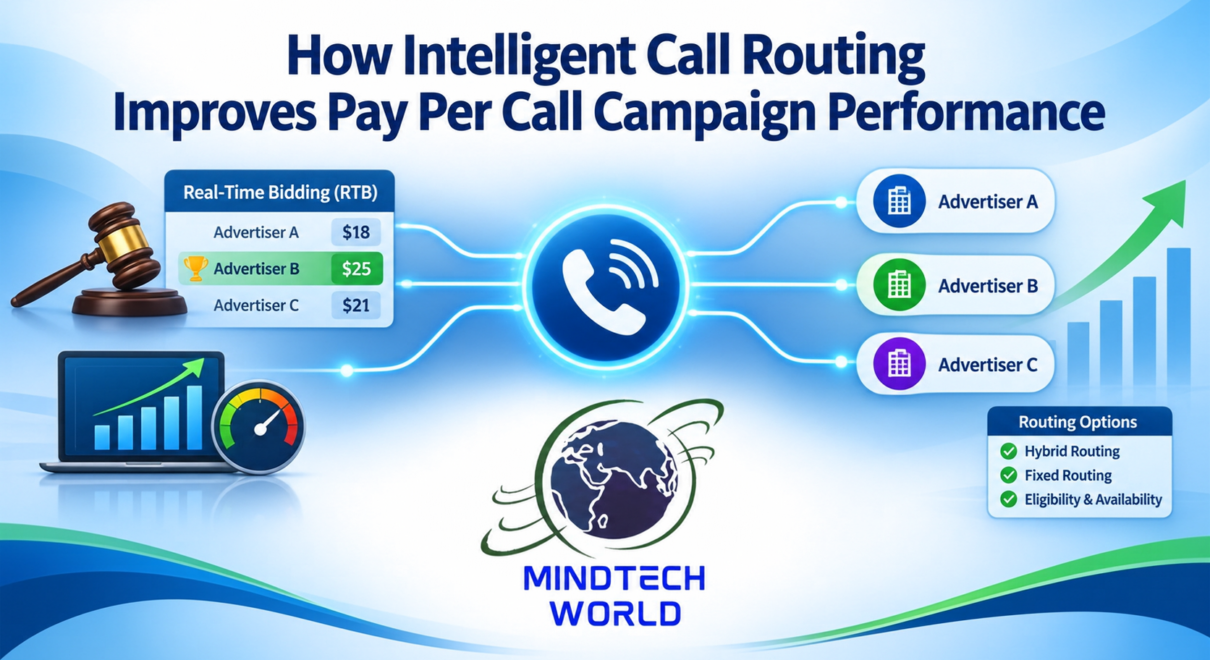
For example, imagine a call network receives an incoming call from a customer looking for an insurance service. Three advertisers are configured to accept calls from that particular location and campaign.
Their bids might look like this:
| Advertiser | Submitted Bid |
|---|---|
| Advertiser A | $18 |
| Advertiser B | $25 |
| Advertiser C | $21 |
If all three advertisers meet the configured requirements, Advertiser B wins the auction with a $25 bid. The RTB engine routes the call to Advertiser B.
This approach allows call networks and lead sellers to identify the highest-paying eligible destination for each incoming call. Instead of accepting a predetermined payout, they can create a competitive environment where advertisers bid according to the value they assign to each opportunity.
2. Hybrid Routing: Combining Auctions with Fixed Distribution
Although RTB offers significant revenue optimisation opportunities, not every campaign needs to operate entirely through an auction. Some advertisers may have negotiated payout agreements, exclusive campaign arrangements, or specific call volume requirements.
Hybrid routing addresses these situations by combining real-time bidding with fixed routing within the same call distribution strategy.
For example, a call network might have five advertisers configured for a particular campaign. Two advertisers may participate in the RTB auction, while the remaining advertisers operate under predefined payout arrangements.
Depending on the configured routing rules, the system can evaluate the eligible destinations and distribute calls through the appropriate routing method.
Hybrid routing is useful when a network wants to maintain existing advertiser relationships while still benefiting from competitive bidding. It provides flexibility to accommodate different commercial agreements without limiting the entire campaign to a single distribution model.
For businesses managing multiple advertisers, this flexibility can help balance guaranteed demand, advertiser commitments, and revenue opportunities.
3. Fixed Routing: Maintaining Predictable Call Distribution
Fixed routing is a traditional call distribution method in which calls are forwarded to predefined advertisers according to configured rules. Unlike RTB, it does not require multiple advertisers to submit bids for every incoming call.
For example, a campaign might be configured to send calls from a particular geographic area directly to Advertiser A. Another campaign could route calls to Advertiser B based on a specific service requirement.
Fixed routing is particularly useful when:
- An advertiser has an exclusive campaign arrangement.
- A negotiated payout has already been established.
- Calls must be directed to a specific business or location.
- The network wants straightforward and predictable call distribution.
- Advertisers have dedicated geographic territories.
While fixed routing does not provide the same auction-based revenue competition as RTB, it remains an important part of a flexible call routing strategy.
The key is selecting the appropriate routing method based on campaign objectives, advertiser agreements, and revenue expectations.
4. How Intelligent Call Routing Improves Campaign Revenue
One of the biggest advantages of intelligent call routing is its ability to improve the monetisation of incoming calls.
In a basic distribution setup, a call might automatically go to the first available advertiser or a predetermined destination. However, that advertiser may not necessarily offer the best payout for the opportunity.
RTB changes this dynamic by allowing multiple advertisers to compete for eligible calls.
When the routing engine evaluates several bids, the call network gains a better understanding of what advertisers are willing to pay for a particular opportunity. Selecting the highest eligible bid can increase the potential revenue generated from each call.
Consider a network that generates 1,000 qualified calls per month. If the average payout increases from $20 to $23 through better advertiser selection, the additional potential monthly revenue would be:
- Existing revenue: $20,000
- Revenue after optimisation: $23,000
- Additional monthly revenue: $3,000
Illustrative example only. Actual results depend on call quality, advertiser demand, eligibility rules, and successful call connections.
Even a relatively small improvement in average payout can make a meaningful difference when a network handles a large volume of incoming calls.
5. Connecting Calls with the Most Suitable Advertisers
Maximising the bid value should not be the only objective of intelligent call routing. The destination must also be suitable for the incoming call.
An advertiser might submit the highest bid but have restrictions that make it ineligible to receive a particular call. These restrictions could involve geographic coverage, service categories, operating hours, campaign requirements, or other predefined conditions.
An intelligent routing engine can evaluate these conditions alongside bidding values before selecting a winner.
For example, if an advertiser only accepts calls from California, the system should not route a call originating from New York to that advertiser. Similarly, if an advertiser is unavailable or does not meet the campaign’s requirements, the routing engine can exclude it from the eligible destinations.
This approach helps ensure that calls are directed to advertisers who can actually handle the opportunities being generated.
Better advertiser matching can also support improved conversion rates, reduce irrelevant calls, and create stronger relationships between call networks and their advertising partners.
6. Improving Advertiser Competition and Campaign Flexibility
Traditional call distribution often depends on previously negotiated payout rates. While these agreements can provide predictable revenue, they may not reflect changing advertiser demand.
Intelligent call routing introduces greater flexibility by allowing networks to configure multiple advertisers for the same campaign and evaluate their offers dynamically.
With RTB, advertisers can adjust their bids according to their current business requirements, available budgets, and demand for incoming calls. This creates a competitive environment in which advertisers have more control over the opportunities they want to acquire.
For call networks, it reduces dependence on a single advertiser and creates more opportunities to monetise incoming traffic.
Hybrid routing further extends this flexibility by supporting both auction-based and fixed payout arrangements. Networks can maintain established partnerships while introducing additional advertisers into the bidding process.
7. Better Control Over Campaign Distribution
Managing multiple advertisers manually can become complicated as call volumes increase. Different advertisers may have different geographic restrictions, payout rates, working hours, and campaign requirements.
Intelligent call routing simplifies this process by centralising call distribution rules within a routing platform.
A network can configure advertiser participation, bidding conditions, destination preferences, and routing priorities according to its business requirements.
This makes it easier to manage multiple campaigns without manually deciding where every incoming call should go.
It also provides greater control over how calls are distributed, allowing campaign managers to adjust routing configurations as advertiser requirements and market conditions change.
8. Reducing Missed Revenue Opportunities
Every incoming call represents a potential revenue opportunity. However, if the selected advertiser cannot answer the call, does not meet the caller’s requirements, or is unavailable, the network may lose the opportunity to monetise that call.
Intelligent call routing helps reduce these situations by considering advertiser availability and campaign conditions before forwarding calls.
For example, a network can configure routing rules that exclude advertisers who are unavailable or do not meet the required campaign conditions. Depending on the platform’s configuration, alternative eligible destinations can be considered.
This is particularly important for call networks handling high volumes of traffic. Even a small number of poorly distributed calls can affect overall campaign revenue.
By maintaining multiple eligible advertiser destinations and applying appropriate routing rules, networks can improve distribution efficiency and make better use of available demand.
9. Making Data-Driven Campaign Optimisation Easier
Intelligent call routing also creates opportunities for better campaign analysis. When a network manages multiple advertisers through RTB, hybrid, and fixed routing, it can evaluate how different distribution strategies perform.
Some important performance indicators include:
- Average payout per call: Measures the average revenue generated from successfully monetised calls.
- Advertiser win rate: Shows how frequently an advertiser wins eligible RTB auctions.
- Call connection rate: Measures how many incoming calls successfully connect to advertisers.
- Call conversion rate: Helps evaluate how effectively connected calls generate sales or qualified opportunities.
- Advertiser performance: Identifies which destinations consistently deliver better campaign results.
- Revenue per incoming call: Helps measure the overall monetisation efficiency of a campaign.
By analysing these metrics, campaign managers can identify advertisers offering competitive bids, understand distribution patterns, and adjust routing configurations to improve performance.
For example, if one advertiser consistently offers competitive bids but generates poor conversion results, the network can review its routing strategy and apply additional eligibility or quality conditions where supported.
This makes intelligent call routing more than just an automated call distribution mechanism. It becomes an important part of ongoing campaign optimisation.
10. Choosing the Right Call Routing Strategy
RTB, hybrid, and fixed routing each serve different business requirements. Choosing the right approach depends on advertiser relationships, campaign objectives, traffic volume, and revenue expectations.
Here is a comparison of the three methods:
| Feature | RTB Routing | Hybrid Routing | Fixed Routing |
|---|---|---|---|
| Advertiser bidding | Yes | Yes, for configured auction destinations | No |
| Multiple advertisers | Yes | Yes | Depends on configured rules |
| Dynamic bid evaluation | Yes | Yes, within auction-based routing | No |
| Predefined payout | Not required | Supported | Supported |
| Revenue optimisation | Auction-based | Combined approach | Based on negotiated rates |
| Best suited for | Competitive advertiser networks | Mixed advertiser arrangements | Dedicated campaigns |
For networks with multiple advertisers competing for the same calls, RTB can provide a strong revenue optimisation mechanism.
For businesses that need to accommodate both negotiated payout agreements and competitive bidding, hybrid routing offers greater flexibility.
Meanwhile, fixed routing remains suitable for campaigns where advertiser destinations and payout arrangements are already established.
Rather than relying on only one method, a call network can use all three approaches across different campaigns to create a distribution strategy that matches its commercial requirements.
How Mindtech World Supports Intelligent Call Routing
Mindtech World on trusted hosting infrastructure provides call routing capabilities designed to help Pay Per Call networks manage incoming calls and distribute them among multiple advertisers.
Its routing approach includes three important methods: Real-Time Bidding (RTB), hybrid routing, and fixed routing.
With RTB, networks can configure multiple advertisers to participate in an auction for incoming calls. When a call arrives, the RTB engine shares the available call information with configured advertisers, collects their bidding responses, compares the submitted values, and evaluates additional routing rules before selecting the winning advertiser.
Hybrid routing provides a combination of auction-based and predefined distribution methods, while fixed routing allows networks to forward calls according to established campaign configurations.
These options give call networks and lead sellers more control over how incoming calls are distributed and monetised. Instead of depending entirely on a single advertiser or a fixed payout arrangement, they can introduce competitive bidding and flexible routing rules into their operations.
Businesses interested in improving their call distribution processes can explore Mindtech World’s call tracking software to learn more about its capabilities.
Conclusion
Intelligent call routing can significantly improve Pay Per Call campaign performance by making call distribution more strategic, flexible, and revenue-focused. Instead of automatically forwarding every incoming call to a predetermined advertiser, networks can evaluate multiple destinations and select the most suitable option based on bidding values and configured campaign conditions.
Real-Time Bidding creates competition among advertisers, helping call networks identify higher-paying opportunities. Hybrid routing combines competitive bidding with predefined payout arrangements, while fixed routing supports campaigns that require predictable call distribution.
Together, these routing methods help publishers, lead sellers, and call networks improve monetisation opportunities, manage advertiser relationships, and make better use of incoming traffic.
As Pay Per Call campaigns grow and advertiser requirements become more complex, intelligent call routing becomes an increasingly valuable part of campaign management. The ability to evaluate multiple advertisers for every eligible call can help networks improve revenue potential while delivering better-matched opportunities to their advertising partners.